

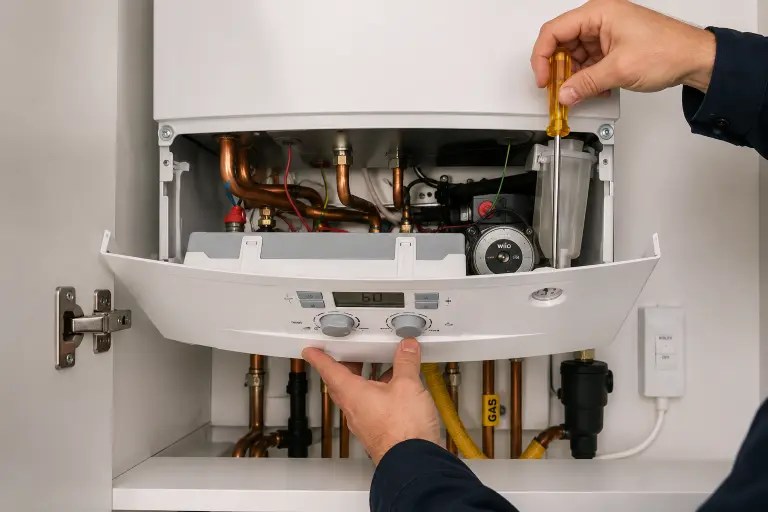
A gas boiler should be serviced once a year. For homeowners that is strong advice rather than the law, but it protects your warranty and your safety. For landlords the rules are stricter: an annual gas safety check is a legal requirement. Here is what applies to you, what a service involves and how it differs from a gas safety certificate.
Key points
- Get a gas boiler serviced every 12 months by a Gas Safe registered engineer.
- Homeowners are not legally required to, but most manufacturer warranties depend on it.
- Landlords must have an annual gas safety check and keep the record for 2 years.
- A gas safety check and a service are different jobs. Landlords should arrange both.
How often should a boiler be serviced if you own your home?
Once every 12 months. There is no law that says an owner occupier has to service their boiler, but there are three good reasons to do it.
- Warranty. Most manufacturers make an annual service by a Gas Safe registered engineer a condition of the boiler warranty. Miss one and a claim can be refused.
- Safety. A service checks that the boiler is burning gas correctly and that the flue is taking fumes out of the house. A badly burning boiler can produce carbon monoxide, which you cannot see or smell.
- Reliability and running costs. Small problems such as a worn seal or a weak sensor get picked up before they leave you without heating, and a clean, correctly set up boiler wastes less gas.
If your boiler is new, check the warranty paperwork for the exact servicing terms and keep every service record.
What landlords must do
If you rent out a property with gas appliances, the Gas Safety (Installation and Use) Regulations 1998 apply. According to the Health and Safety Executive, you must:
- Have an annual gas safety check on each gas appliance and flue you provide, carried out by a Gas Safe registered engineer, within 12 months of a new appliance being fitted and every year after that.
- Keep the record of each check for 2 years.
- Give a copy to existing tenants within 28 days of the check, and to new tenants before they move in.
- Keep gas appliances, flues and pipework maintained in a safe condition. HSE describes regular annual maintenance as good practice.
Since 2018, you can have the check done up to 2 months before it is due and keep the original anniversary date, which makes it easier to schedule without losing time on the certificate.
In England, landlords must also fit a carbon monoxide alarm in any room used as living accommodation that has a fixed combustion appliance such as a gas boiler (gas cookers are excluded), under the Smoke and Carbon Monoxide Alarm (Amendment) Regulations 2022.
We carry out landlord gas safety checks and CP12 certificates in St Albans and the surrounding area.
Boiler service vs gas safety check
They sound alike, but they do different jobs.
- A gas safety check (the landlord certificate, often called a CP12) confirms that gas appliances, flues and pipework are safe to use at the time of the visit. It is a legal requirement for landlords.
- A boiler service goes further on the boiler itself. The engineer opens it up, inspects and cleans the parts, and checks that it is running efficiently, so faults are found before they cause a breakdown.
A boiler can pass a safety check and still be close to failing. For a rental property, booking the service and the safety check at the same visit is the simplest way to meet the legal duty and keep the boiler reliable for your tenants.
What happens during a boiler service
A full service usually takes around an hour. Our Gas Safe registered engineers:
- Check the gas pressure and flue gas readings to make sure the boiler is burning safely and efficiently.
- Inspect and clean the main components, including the burner and heat exchanger where needed.
- Check the seals, safety devices and controls.
- Make sure the flue is clear, secure and correctly positioned.
- Check the system pressure, the condensate pipe and, where fitted, clean the magnetic filter.
- Tell you about anything that needs attention and record the service.
You can read more on our boiler servicing page. If your home has an unvented hot water cylinder, that should also be serviced regularly, and we can service that too through our unvented cylinder service.

When to book sooner than a year
Do not wait for the annual date if you notice any of these. Some of them mean the boiler needs a repair rather than a service, and our guide to boiler service or boiler repair explains which visit to book.
- A yellow or orange flame instead of a crisp blue one.
- Black soot or staining around the boiler.
- The pressure keeps dropping below 1 bar.
- New noises such as banging, whistling or gurgling.
- Fault codes, or the boiler locking out.
- Your carbon monoxide alarm sounds.
Is your boiler due a service?
Book your annual boiler service or landlord gas safety check with our Gas Safe registered engineers. We cover St Albans and the surrounding Hertfordshire towns.
Frequently asked questions
Is it a legal requirement to service my boiler?
Not for homeowners. Landlords must have an annual gas safety check and keep gas appliances maintained in a safe condition. Most manufacturers also require an annual service to keep the warranty valid.
What happens if I do not service my boiler?
You risk invalidating the warranty, small faults can turn into breakdowns, and problems with combustion or the flue can go unnoticed. That can affect both running costs and safety.
Is a gas safety certificate the same as a boiler service?
No. A gas safety check confirms appliances, flues and pipework are safe at the time of the visit. A service also cleans and inspects the boiler’s internal parts to keep it working efficiently.
How long does a boiler service take?
Usually around an hour, although it can take longer if the boiler needs extra cleaning or the engineer finds something that needs attention.
When is the best time of year to service a boiler?
Late summer or early autumn, before the heating goes on for winter. If yours is overdue, book it as soon as you can rather than waiting for the cold weather.

Comments are closed