

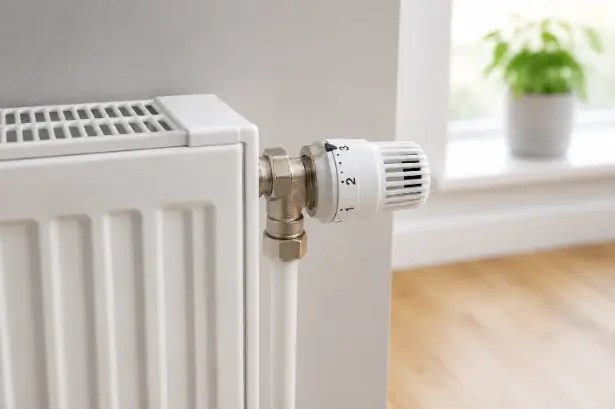
To bleed a radiator, turn the heating off and let the radiators cool, open the bleed valve at the top corner a quarter turn with a radiator key until the hissing stops and water appears, then close it and check your boiler pressure. It takes about five minutes per radiator. This guide walks through each step, the order to do them in, and what it means if a radiator keeps needing bleeding.
Key points
- Bleed radiators with the heating off and the radiators cool. Hot water from a bleed valve can scald.
- A radiator that is cold at the top and warm at the bottom, or one that gurgles, usually has air in it.
- Bleeding lowers the system pressure. On a combi or system boiler, check the gauge afterwards and top up to about 1 to 1.5 bar if needed.
- If the same radiator needs bleeding every few weeks, something is letting air or gas into the system and it is worth getting checked.
Signs a radiator needs bleeding
Air collects at the highest point of a radiator, so the classic sign is a radiator that is cold at the top and warm at the bottom. Other signs are:
- Gurgling, trickling or bubbling noises when the heating comes on.
- A radiator that takes much longer to warm up than the others.
- Cold patches across the top of the panel.
- Radiators feeling weak at the start of winter after the heating has been off all summer.
If the radiator is warm at the top and cold at the bottom, or cold all over, bleeding will not fix it. That points to sludge, a stuck valve or a balancing problem, which our guide to radiators not heating up covers in detail.
What you need
- A radiator key. These cost a couple of pounds from any DIY shop. Some newer radiators have a slotted valve that takes a flat head screwdriver instead.
- An old towel or cloth to wrap around the key and catch drips.
- A small container, such as a cup or a bowl, to hold under the valve.
- Access to the boiler so you can check the pressure gauge when you finish.
How to bleed a radiator, step by step
- Turn the heating on and find the problem radiators. Let the system run for 10 to 15 minutes, then carefully feel the top and bottom of each radiator. Make a note of any that are cold at the top.
- Turn the heating off and let it cool. Switch the heating off at the programmer or thermostat and wait until the radiators are cool enough to touch. Bleeding a hot radiator can spray scalding water, and with the pump off, air is easier to release.
- Find the bleed valve. It is a small square or slotted fitting at one of the top corners of the radiator, usually on the opposite side to the pipework.
- Open the valve slowly. Fit the key, hold the towel and container underneath, and turn anticlockwise about a quarter to half a turn. You should hear air hissing out. You do not need to remove the valve, and opening it too far can let it come out completely.
- Close it as soon as water appears. When the hissing stops and a steady trickle of water comes out with no spitting, turn the key clockwise to close the valve. Snug is enough. Overtightening can damage the valve seat.
- Move on to the next radiator. Repeat for every radiator that was cold at the top, working in the order explained below.
- Check the boiler pressure and turn the heating back on. Then go round again after half an hour to make sure every radiator is heating evenly from top to bottom.
Which radiator to bleed first
In a two storey house, start downstairs with the radiator furthest from the boiler and work your way back towards it. Then do the same upstairs. Air tends to move up through the system, so finishing upstairs means you are not pushing air back into radiators you have already done.
If you only have one cold radiator, you can just bleed that one. Bleeding radiators that are already heating properly does no harm, but it lowers the pressure each time.
Check the boiler pressure afterwards
Most UK homes have combi or system boilers on a sealed system. Every time you let air out, the pressure falls a little. If it drops too far, the boiler will lock out to protect itself and you will have no heating at all.
- With the heating off and cold, the gauge should read roughly 1 to 1.5 bar. Check the manual or the label on your boiler for the exact figure.
- If it reads below 1 bar, top it up using the filling loop under the boiler. Our guide on how to check and repressurise a boiler explains this step by step.
- If you have an older open vented system with a small tank in the loft, there is no pressure gauge to worry about. The tank refills the system automatically.
If a radiator keeps needing bleeding
One bleed at the start of winter is normal. Needing to bleed the same radiators every week or two is not, and usually means one of these:
- Corrosion inside the system. Rusting steel radiators produce gas that collects like air. If the water you bleed out is black, the system has sludge and the inhibitor has probably run out.
- A small leak on a valve or joint, which lets air in as water escapes. Check the valves and joints on each radiator for damp patches, crusty white or green deposits, or drips into a tissue held underneath.
- A pump or system design problem that is drawing air in, which is more common on older open vented systems.
These problems shorten the life of the boiler, so it pays to deal with them early. A powerflush clears out sludge and restores the inhibitor, and an annual boiler service includes a check of the system pressure and condition.
Radiators still cold after bleeding?
If bleeding has not fixed it, or the pressure will not hold, our Gas Safe registered engineers can find the cause. Call us and we will give you a price over the phone before any work starts.
Frequently asked questions
Should the heating be on or off when you bleed a radiator?
Off. Run the heating first to find the cold radiators, then turn it off and wait for them to cool before opening the valve. The water inside can be hot enough to scald.
How do I bleed a radiator without a key?
Many modern bleed valves have a slot that takes a flat head screwdriver. If yours has a square fitting, you need a radiator key. They are cheap and sold in DIY shops and supermarkets, and it is worth keeping one in a kitchen drawer.
How often should you bleed radiators?
Only when they show signs of trapped air. For most homes that means a quick check at the start of the heating season in autumn. Needing to bleed them every few weeks points to a fault that should be looked at.
Does bleeding radiators lower boiler pressure?
Yes, on a sealed system with a combi or system boiler. Check the gauge when you finish and top up to around 1 to 1.5 bar if it has dropped below 1 bar.
Why is the water from my radiator black?
Black water is sludge, made of iron oxide from corrosion inside the radiators and pipework. It can block radiators and damage the boiler over time. A powerflush and fresh inhibitor usually sort it out.
What if no air or water comes out of the bleed valve?
The valve may be blocked with paint or sludge, or the system pressure may be too low to push anything out. Check the boiler pressure first. If it is fine and nothing comes out, close the valve and get an engineer to look at it.

Comments are closed