

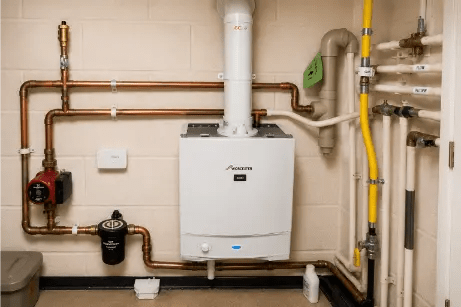
Low boiler pressure is the most common reason a combi boiler stops working, and in many cases you can fix it yourself in five minutes. Here is how to check the pressure, top it up safely and spot the signs that the real problem is a leak.
Key points
- Normal pressure is about 1 to 1.5 bar when the heating is cold.
- Below 1 bar most combi boilers lock out and show a fault code.
- Top up with the filling loop, slowly, then close both valves fully.
- If it keeps dropping, there is a leak or a faulty part: book a repair.
How to read the pressure gauge
Most combi and system boilers have a dial or digital readout on the front. With the heating off and cold, it should read between 1 and 1.5 bar. It will rise slightly when the heating is running, which is normal. If it sits below 1 bar, or the boiler shows a low pressure fault code, the system needs topping up.
How to repressurise your boiler
- Turn the boiler off and let the system cool down.
- Find the filling loop. It is usually a silver braided hose or a built-in lever under the boiler, with a valve at each end.
- Open the valves slowly, one then the other. You will hear water flowing.
- Watch the gauge and close both valves when it reaches 1.2 to 1.5 bar.
- Turn the boiler back on and reset it if it shows a fault code.
Why boiler pressure keeps dropping
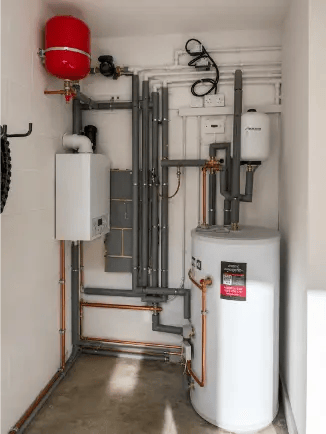
Topping up once after bleeding the radiators is normal. Having to do it every week is not. The usual causes are a slow leak on a radiator valve or under the floor, a failed pressure relief valve that is letting water out through the pipe on the outside wall, or a faulty expansion vessel inside the boiler. Each one needs a boiler repair, and a hidden leak may need leak detection. If you can see water spraying from a pipe, follow our burst pipe guide.
When pressure is too high
If the gauge reads above 2.5 bar, the filling loop may have been left open or be letting by. Close both valves and bleed a radiator to bring it down. If it climbs again on its own, call an engineer.
Boiler still losing pressure?
Our Gas Safe engineers will find the leak or faulty part and fix it, usually on the first visit.
Frequently asked questions
What should my boiler pressure be?
Between 1 and 1.5 bar when the system is cold, rising to around 2 bar when the heating is running.
Is low boiler pressure dangerous?
No, it is not dangerous. The boiler simply locks out to protect itself, so you lose heating and hot water until it is topped up.
Why does bleeding radiators lower boiler pressure?
Bleeding lets air out of the system, and the pressure drops as the air is replaced. Top up with the filling loop afterwards.
Should I get my boiler serviced if the pressure keeps dropping?
A service will not fix a leak. Book a repair so the engineer can trace the cause. It is worth keeping up the annual service too, as it catches worn parts early.

Comments are closed