

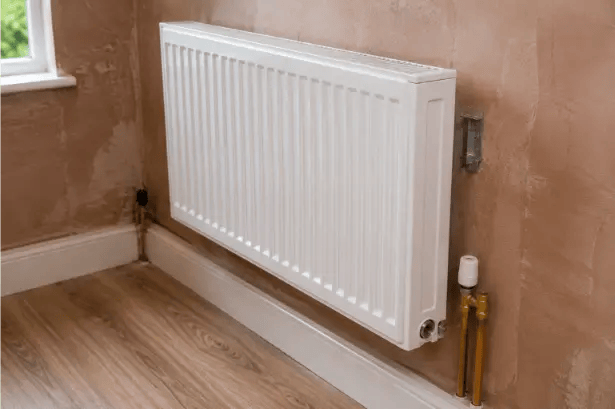
A radiator that stays cold while the rest of the house warms up is one of the most common heating complaints we get through the autumn. The good news is that where the radiator is cold usually tells you why. Here is how to read the pattern, what you can safely sort yourself and when it is time to call a heating engineer.
Key points
- Cold at the top and warm at the bottom usually means trapped air. Bleeding the radiator fixes it.
- Warm at the top and cold at the bottom usually means sludge. That needs a flush, not bleeding.
- One radiator completely cold is often a stuck valve pin or a closed valve.
- Every radiator cold points to the boiler, the pump or the controls: call an engineer.
Quick checks first
Before you reach for a radiator key, rule out the simple things. They catch more people out than you would think, especially when the heating has been off all summer.
- Is the heating actually calling for heat? Turn the room thermostat up a few degrees above the room temperature and check the timer or app is set to on.
- Is the thermostatic radiator valve (the numbered head on the side of the radiator) turned up? Try setting it to the highest number.
- Is the boiler pressure gauge between about 1 and 1.5 bar with the system cold? If it is below 1 bar, follow our guide to repressurising your boiler.
- Has the heating been on for at least 20 minutes? Large radiators and those at the end of a long pipe run take a while to warm through.
Radiator cold at the top, warm at the bottom
This is the classic sign of air in the radiator. Air rises and collects at the top, so hot water cannot fill the whole panel. You may also hear gurgling. Bleeding the radiator lets the air out.
- Turn the heating off and let the radiators cool. Bleeding a hot radiator can spray scalding water.
- Find the bleed valve, a small square fitting at one of the top corners. You will need a radiator key, available from any hardware shop.
- Hold a cloth under the valve and turn the key anticlockwise about a quarter turn. You will hear air hissing out.
- Close the valve as soon as water starts to appear. Do not open it further than you need to.
- Check the boiler pressure. Bleeding lowers it, so top up with the filling loop if it has dropped below 1 bar, then turn the heating back on.
Radiator warm at the top, cold at the bottom
When the top is hot and the bottom half stays cool, bleeding will not help. The usual cause is sludge: a black, muddy mix of rust and debris (mostly magnetite) that forms inside steel radiators and pipework over the years. It settles along the bottom of the panel and blocks the flow, which is why radiator manufacturer Stelrad also points to sludge as the cause of a cold bottom.
Other clues that sludge is building up include dark or black water when you bleed a radiator, cold patches in the middle of panels, a noisy boiler and radiators that take longer and longer to warm up.
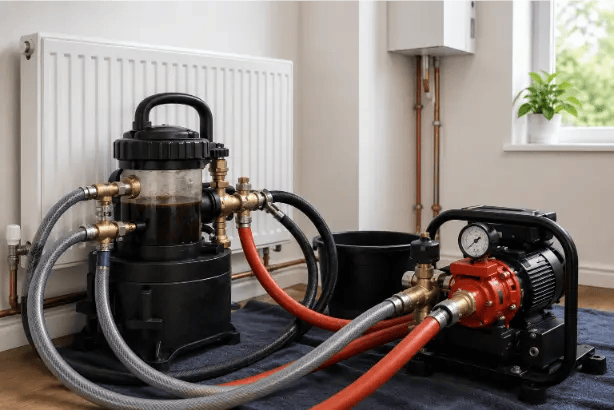
One badly affected radiator can sometimes be taken off the wall and flushed out on its own. If several radiators show the same symptoms, the whole system needs cleaning. A central heating powerflush pumps cleaning chemicals through the system at high flow to lift the deposits out. Afterwards the system should be refilled with inhibitor, and a magnetic filter on the return pipe to the boiler helps catch any new debris before it causes problems.
One radiator cold all over
If every other radiator is hot and one is stone cold from top to bottom, the problem is usually at that radiator’s valves rather than the boiler.
- Stuck thermostatic valve pin. This is very common after the summer. Unscrew the thermostatic head (with the heating on) and you will see a small metal pin. It should move in and out freely when pressed. If it is stuck down, gently tap or wiggle it until it springs up. If it will not move, the valve may need replacing.
- Closed lockshield valve. The plain cap on the other end of the radiator controls how much water flows through it. If someone has decorated or moved the radiator, it may have been closed. Count the turns as you open it so you can reset it if needed.
- Airlock or blockage. If both valves are open and the radiator still stays cold, there may be an airlock or a blocked inlet, which an engineer can clear.
Radiators furthest from the boiler are cooler
If the radiators near the boiler get hot quickly but the ones at the far end of the house or upstairs never quite get there, the system is probably unbalanced. Hot water takes the easiest route, so the nearest radiators get most of it. Balancing means adjusting each lockshield valve so the flow is shared evenly. It takes time and a thermometer to do properly, so most people leave it to a heating engineer, and it is worth doing whenever radiators are added or replaced.
Weak circulation can look the same, so if balancing does not cure it, the pump or the amount of sludge in the system needs looking at.
All the radiators are cold
When none of the radiators heat up, the fault is almost always with the boiler, the pump or the controls rather than the radiators themselves. Check whether you have hot water. If the hot water works but the heating does not, the cause on a combi boiler is often the diverter valve, which switches the boiler between heating and hot water. If you have neither, our guide to no hot water from a combi boiler walks through the checks to make first.
Anything beyond resetting the boiler or topping up the pressure needs a boiler repair by a Gas Safe registered engineer.
When to call a heating engineer
Call us if bleeding and the valve checks do not fix it, if you need to bleed the same radiator again and again, if the water you bleed out is black, if several radiators are cold at the bottom, or if no radiators heat up at all. These point to sludge, a failing pump or valve, or a boiler fault, and guessing at them usually costs more in the long run.
If a radiator is old, leaking from the panel itself or simply too small for the room, replacing it can be the better fix. Our radiator installation team can size the right replacement for the room.
Radiators still cold?
Our Gas Safe registered heating engineers cover St Albans and the surrounding Hertfordshire towns. Tell us which radiators are cold and where, and we will tell you what is likely to be wrong.
Frequently asked questions
Why is my radiator cold at the bottom but hot at the top?
It is usually sludge (rust and debris) sitting along the bottom of the radiator and blocking the flow of hot water. Bleeding will not fix it. The radiator, or the whole system, needs flushing.
Why is my radiator cold at the top but hot at the bottom?
Air has collected at the top of the radiator. Turn the heating off, let it cool, then bleed it with a radiator key and top up the boiler pressure afterwards.
Why is only one radiator not heating up?
The most common causes are a stuck pin in the thermostatic valve, a lockshield valve that has been closed, or an airlock. If both valves are open and moving freely, call an engineer.
Do I need a powerflush if my radiators are cold?
Only if the cause is sludge. Signs include radiators cold at the bottom, dark water when bleeding and several radiators affected at once. Air or a stuck valve does not need a powerflush.
Why are my upstairs radiators cold when downstairs is warm?
It can be air collecting in the upstairs radiators, a system that needs balancing, or weak circulation from the pump. Bleed the upstairs radiators first. If that does not help, have an engineer check the balancing and the pump.

Comments are closed